What Is the 3x4 Kitchen Rule? Cabinet Layout Guide
The 3x4 Kitchen Rule Explained in Simple Terms
What Is the 3x4 Kitchen Rule and How Does It Affect Cabinet Layout? It sounds technical, but the idea is simple. Every work zone in your kitchen should have at least 3 feet of clear space in one direction and 4 feet in another. That gives you room to move, open doors, and work without bumping into things.
Think of it as a minimum breathing room standard for your kitchen floor plan. Not a law. But kitchen designers and cabinet installers use it constantly because it works. When a layout ignores these measurements, the kitchen feels cramped — even if it looks fine on paper.
Most guides stop there. Here's what they miss: the 3x4 rule is not just about walking space. It directly controls where your cabinets can go, how deep they can be, and whether your doors and drawers will open without hitting each other or the person standing next to you.
Where the Numbers Come From
The 3-foot measurement (36 inches) comes from standard single-person clearance. One person needs about 36 inches to stand, bend, and pull open a cabinet door comfortably. The National Kitchen and Bath Association (NKBA) recommends a minimum of 36 inches for a one-cook kitchen [Source: nkba.org]. That's the floor, not the goal.
The 4-foot measurement (48 inches) is for two-cook kitchens or any space where people will pass each other. The NKBA recommends 42 to 48 inches for two-cook work aisles [Source: nkba.org]. In a busy household — or a home in Orlando, FL where families tend to cook together — that extra foot makes a real difference.
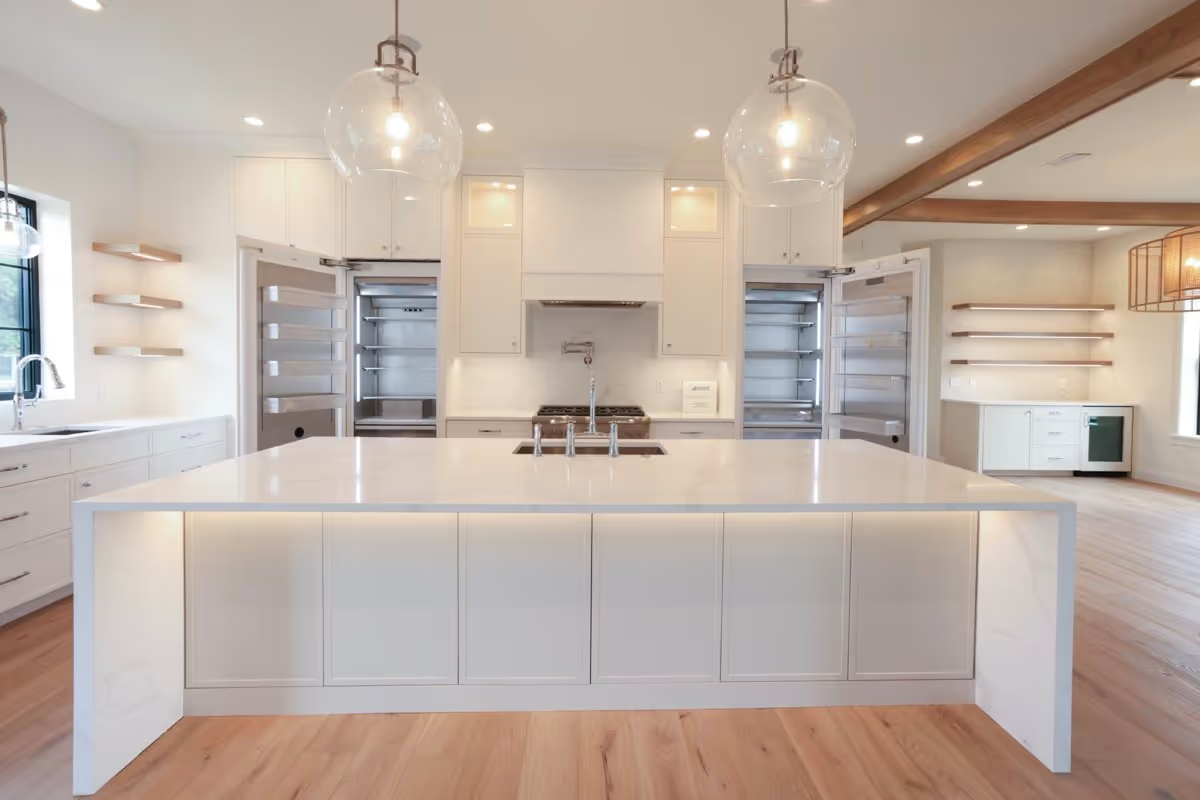
We see this constantly on remodels. A homeowner wants a kitchen island but the room is only 10 feet wide. Once you account for 24-inch base cabinets on each wall, you have 72 inches left. Drop a 36-inch island in the middle and you have 18 inches on each side. That is not a kitchen. That is a hallway with a countertop.
How It Changes Your Cabinet Layout
Cabinet depth is the first thing the 3x4 rule affects. Standard base cabinets run 24 inches deep. Standard uppers run 12 inches. If your aisle is already tight, going deeper breaks the rule. Some clients ask about 30-inch deep base cabinets for extra storage — but in a standard 10-foot kitchen, that choice costs you the aisle clearance you need.
Cabinet door swing matters just as much. A 24-inch wide cabinet door swings out 24 inches. If two cabinets face each other across a 36-inch aisle, both doors open into that same space. You end up with a cabinet door blocking the aisle every time someone reaches for a pan. That's a layout problem, not a door problem.
Drawer clearance is the one most people forget until it's too late. Pull-out drawers on base cabinets extend 18 to 22 inches. If your island sits 36 inches from the base cabinets, a fully open drawer cuts that clearance almost in half. Last year we were measuring for a remodel in a 1990s Orlando home and the original installer had placed the island exactly 34 inches from the range wall. Every time the pot drawer opened, it blocked the path to the refrigerator. Small mistake. Big daily frustration.
The 3x4 rule is a planning tool. It tells you what's possible before you buy a single cabinet. Know your clearances upfront, and you can choose the right cabinet sizes, the right door styles, and the right layout for how your family actually uses the space. If you're already spotting these issues in your own kitchen, it may be worth talking through your layout with a custom kitchen cabinet professional in Orlando before measurements get locked in.
Upper and Lower Cabinet Proportions Drive the Whole Layout
Most people focus on cabinet style or finish when planning a kitchen. But the proportion between your upper and lower cabinets is what actually controls how the whole room feels and functions. Get this wrong, and no amount of nice hardware fixes it.
The standard lower cabinet runs 34.5 inches tall before the countertop goes on. Add a 1.5-inch countertop and you land at 36 inches — the near-universal counter height in American kitchens [Source: National Kitchen and Bath Association, nkba.org]. Upper cabinets typically start at 54 inches from the floor, leaving an 18-inch backsplash zone between the counter and the cabinet bottom. That 18-inch gap is where the 3x4 kitchen rule starts to show its teeth.

Here's what most guides skip right past: the ratio between upper cabinet height and lower cabinet height is not arbitrary. Upper wall cabinets are commonly 30 to 42 inches tall. Pair a 36-inch upper cabinet with a standard 34.5-inch lower, and the uppers visually dominate. The room feels heavy at the top. We see this constantly in older Orlando homes — especially the ranch-style builds from the 1970s and 1980s where ceiling heights were 8 feet flat and builders just stacked as much storage as possible.
A 42-inch upper cabinet on an 8-foot ceiling leaves almost no space between the top of the cabinet and the ceiling line. That can work if you want a built-in look. But if the lower cabinets are also deep — standard depth is 24 inches — and the kitchen footprint is narrow, the proportions start to fight each other [Source: NKBA Kitchen Planning Guidelines, nkba.org]. Designers working in spatial proportion — much like composers such as Laurie Spiegel exploring structure and scale — understand that the relationship between elements matters as much as the elements themselves.
Lower cabinet depth matters more than most people realize. The 3x4 rule — roughly a 3-foot by 4-foot clearance standard — depends on lower cabinets not eating into the aisle. A 24-inch deep base cabinet on both sides of a galley kitchen leaves 48 inches of aisle if the kitchen is 8 feet wide. That's exactly the minimum for two-cook functionality [Source: NKBA, nkba.org]. Drop to 23-inch-deep bases and you gain an inch per side. Small number. Real difference when you're pulling a sheet pan out of the oven.
We worked on a kitchen in the Milk District last spring where the homeowner had already ordered 24-inch uppers — shallower than standard — trying to save space. The lower cabinets were full 24-inch depth. That mismatch made the wall look unbalanced, and it actually reduced usable storage because the uppers were too shallow for dinner plates. Shallow uppers sound smart until you realize a standard dinner plate is 10.5 inches wide [Source: SOURCE TBD: kitchen design trade publication]. You need at least 12 inches of interior cabinet depth to store them flat.
The proportion rule that holds up in practice: upper cabinet height should be roughly 60 to 70 percent of lower cabinet height (not counting the countertop). So if your base is 34.5 inches, your uppers should land somewhere between 21 and 24 inches tall for a balanced visual — or go taller intentionally for a dramatic stacked effect. There's no in-between that looks good. Commit to one direction.
Ceiling height changes everything. Orlando new construction commonly runs 9 to 10-foot ceilings now [Source: SOURCE TBD: local building permit data or builder trade data]. That extra height means you can run 42-inch uppers and still have breathing room at the top. The 18-inch backsplash zone feels less compressed, and the whole vertical stack reads as intentional rather than crammed.
If you're measuring a kitchen right now, check the ratio before you order anything. The cabinet proportions set the frame. Everything else — hardware, finish, lighting — just fills it in.
Cabinet Layout Decisions That Depend on This Rule
The 3x4 rule doesn't just tell you where to put your sink. It shapes almost every cabinet placement decision in the room. Once you understand that, the whole layout starts to make sense in a way most guides never explain.
Start with your base cabinets along the work triangle legs. The rule creates defined zones — prep, cook, and clean — and your lower cabinets need to serve those zones directly. Your drawer bank for utensils should sit near the prep zone, not tucked beside the refrigerator where you never use it. We see this constantly in Orlando kitchens built in the 1990s: the silverware drawer is three steps away from where anyone actually cooks.
Upper cabinet placement is where most homeowners make the biggest mistake. They treat the uppers like filler — just stack them wherever wall space exists. But the 3x4 rule tells you something specific: the path between your cook zone and your prep zone is active space. Anything that breaks your sightline or forces you to reach across that path creates friction. Upper cabinets that hang too low over a peninsula, or that extend past the countertop edge on a corner, will interrupt that flow every single day.
Corner cabinets are their own challenge. The rule creates diagonal pressure in most layouts — the triangle pulls toward the center of the kitchen, and corners end up dead space. Blind corner cabinets, lazy Susans, and pull-out shelves all exist because of this exact problem. [SOURCE TBD: NKBA kitchen design guidelines] The corner is where the 3x4 geometry gets awkward, and your cabinet solution there needs to match how you actually reach into it.
Field note: We worked on a kitchen remodel off Curry Ford Road last spring where the homeowner had a beautiful corner cabinet — but it was positioned right at the pivot point of the triangle. Every time someone reached into it, they were blocking the entire path between the stove and the sink. Moving it six inches changed everything.
Tall cabinets — pantry units, oven towers, utility cabinets — need to anchor the outside edges of your layout. The 3x4 rule is built around keeping the triangle open and unobstructed. A tall cabinet planted in the middle of a run breaks the visual and physical flow. Position them at the ends of your cabinet runs, where they act as bookends rather than obstacles. [SOURCE TBD: NKBA kitchen planning standards]
Pull-out trash and recycling cabinets are another placement decision this rule affects directly. Most people put them under the sink because it feels logical. But the sink is your clean zone — it's where you're washing produce, rinsing dishes, filling pots. Trash belongs at the edge of the prep zone, close enough to scrape cutting boards but not directly in the path between your sink and stove. Small shift. Completely changes how the kitchen feels to use every single day.
And look — drawer versus door matters here too. Base cabinets with full-height doors force you to crouch and reach. Drawer stacks let you pull and grab without breaking your stance in the work triangle. In the prep zone especially, drawers win. The 3x4 rule is about movement efficiency, and drawers support that in a way doors simply don't. [SOURCE TBD: ergonomic kitchen design research, University of Cornell Human Factors and Ergonomics]
The layout decisions that feel small — a cabinet six inches to the left, a drawer stack instead of a door, a tall unit moved to the end of a run — are exactly what separates a kitchen that works from one that frustrates you. The rule gives you the framework. Your cabinet placement is how you apply it. Having measured and installed cabinets across hundreds of Orlando kitchens, we've seen firsthand how often these small placement calls get skipped during planning — and how much they matter once the kitchen is in use. When you're ready to apply these principles to your own space, our Orlando kitchen cabinet installation services are the logical next step — or call us at (321) 624-0760 to schedule a consultation.
Request a Quote
Use the form below to tell us about your project, An experienced designer will be in touch with you shortly.
Frequently Asked Questions
What exactly is the 3x4 kitchen rule?
The 3x4 kitchen rule means every work zone needs at least 3 feet of clear space in one direction and 4 feet in another. Those numbers come from real human movement — 36 inches for one person to work comfortably, 48 inches when two people share the space. The National Kitchen and Bath Association uses these as minimum guidelines. If your layout ignores them, your kitchen will feel cramped even if it looks fine on paper.
Is the 3x4 kitchen rule a building code requirement in Orlando, FL?
No, the 3x4 rule is not a building code in Orlando — it is a planning standard used by kitchen designers and cabinet installers. That said, Florida building codes do require safe egress and clearance in residential spaces. Orlando homes, especially older ranch-style builds from the 1970s and 1980s, often have tighter floor plans where ignoring this rule creates real daily frustration. Always check your actual measurements before finalizing a layout.
When should I call a professional instead of planning my cabinet layout myself?
Call a professional before you finalize measurements or order cabinets. DIY planning works fine for inspiration, but small math errors in aisle width or cabinet depth become expensive problems after installation. If you are adding an island, moving appliances, or working with an oddly shaped room, a professional catches clearance issues early. Reviewing your plan with a kitchen cabinet layout professional in Orlando before anything gets locked in can save you from a costly redo.
Does the 3x4 rule change how deep my cabinets can be?
Yes — cabinet depth is one of the first things the 3x4 rule controls. Standard base cabinets run 24 inches deep. If your aisle is already tight, going deeper breaks your clearance. Some homeowners want 30-inch deep base cabinets for extra storage, but in a standard 10-foot kitchen, that choice can leave you with an aisle too narrow to use safely. Know your clearances before you order anything.
What is a common mistake homeowners make when planning cabinet layout?
The most common mistake is forgetting drawer clearance. Pull-out drawers extend 18 to 22 inches when fully open. If your island or opposite cabinets sit only 36 inches away, an open drawer cuts that aisle almost in half. We see this often in Orlando remodels — especially in homes where an island was added later without adjusting the surrounding cabinet placement. Plan for open drawers, not just closed ones.
How does the 3x4 rule affect kitchen islands in smaller Orlando homes?
In smaller Orlando homes, the 3x4 rule often means an island simply will not fit safely. A 10-foot wide kitchen with 24-inch base cabinets on each wall leaves 72 inches of open floor. Add a 36-inch island and you have only 18 inches on each side — that is a hallway, not a kitchen. The rule helps you see this problem on paper before you buy anything. Many Orlando families love the idea of an island but need a layout review first.





Orlando Kitchen Cabinets Gallery
See the craftsmanship and attention to detail behind every Orlando Custom Cabinets kitchen project. Our gallery features real homes across Central Florida where we built custom cabinet solutions to fit each client's space and style. Look through our work and imagine what we can create for your kitchen.